| |
modernmicroscopy
:
articles
A Microscopical Study of Exotic Animal Hair: Part 1
| by |
Kristen D. Partin, McCrone Associates, Westmont, IL |
| 10/23/2003 (revised 7/7/2004) | 1 | 2 | 3 | 4 | 5 | 6 | 7 | NEXT>> |
The wild animal realm is one in which a microscopist
may never even think to focus on. Brookfield Zoo, Brookfield, IL, is the
home to numerous exotic animals from all over the world. A collection
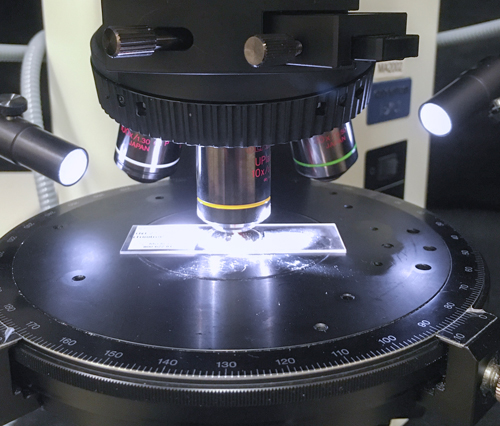
of animal hairs from an array of animals at the Zoo was examined, and
photomicrographs were made using polarized-light microscopy (PLM) and
scanning electron microscopy (SEM). After a long proposal, and approval
from the Zoo, a project was initiated that would benefit not only McCrone
Associates, but the Zoo as well. The plan was to set up a display at the
Zoo featuring the images of the exotic hairs; McCrone Associates would
be acknowledged as the provider of the images.
What is hair? Webster defines hair as a slender threadlike
outgrowth of the epidermis of an animal. Hair comes in an array of colors,
textures, sizes, and shapes. There are two distinct parts, the hair bulb,
or root, and the hair shaft. Just beneath the surface of the epidermis
lie tiny cup-shaped pits within the fat of the scalp; these cavities are
known as hair follicles. The hair bulb lies within the hair follicle;
it is the structure that contains actively growing and dividing cells. As
new cells are formed, they steadily push the previously formed cells upwards. Also
within the follicle, lies the mid-follicle region. Here the actively growing
cells die and harden, and consist of the protein, keratin. Eventually
these “scales” are pushed upwards, and out of the skin, creating the shaft.
There are three main regions that make up the shaft
of the hair: the cuticle, cortex, and medulla. The cuticle is a thin translucent
layer on the exterior of the shaft. Cuticle scales, formed as the hair
grows outward and consisting of keratinized cells, are usually overlapping,
non-nucleated, and pigment-free. The cortex is the main body of the shaft,
and is composed of elongated, filamentous cells that grow parallel to
the shaft. The cortex may also contain tiny air spaces called fusi, and
even smaller pigment granules. The medulla is a hollow, cellular, central
core that, when present, runs through the center of the cortex. Its structure
may be fragmentary, continuous, or discontinuous. Medullas from lower
animals tend to be very regular and well defined. These medulla types
are known as uniserial or multiserial ladder, cellular or vacuolated,
and lattice. The main function of the medulla is to provide protection
and temperature stability by adding internal air spaces. The medullary
index is also a valuable tool for species differentiation; it can be calculated
by dividing the average width of the medulla by the average width of the
cortex. However, the medulla may differ from one hair to another on the
same species.
Why study hair? One reason is for animal identification;
it is helpful to differentiate between animals of similar species. The
scale pattern on a hair is one of the important identifying characteristics
and can almost always be used as a “finger print”. Every species has its
own scale pattern unique to them. Another reason why one may study hairs
is for animal distribution; certain areas are surveyed to determine if
a species is present in that area. A third reason why one may study hair
is because it’s fun, it’s inspiring, and it’s educational too.
The animals reviewed here have been chosen because
they are all either endangered or threatened in the wild. When this happens,
a species survival plan (SSP) may be developed to help prevent the animal
from becoming extinct. SSPs are cooperative breeding programs between
zoos that aim to increase the captive population of endangered species.
Currently there are 87 SSPs covering 116 species throughout 183 zoos within
North America. Brookfield Zoo has 44 endangered species within their collection.
| 10/23/2003 (revised 7/7/2004) | 1 | 2 | 3 | 4 | 5 | 6 | 7 | NEXT>> |
|