| |
modernmicroscopy
:
columns
:
true colors
True Colors
The Microscope in Art Conservation and Authentication Studies
| by |
Joe G. Barabe, McCrone Associates, Westmont, IL |
Part 2
Protocols for Painting Analysis
Our analyses are directed to determining the earliest
possible date of creation of the painting, based on our ability to identify
materials constituting the work and our knowledge about their dates of
discovery or invention.
The opaque white pigments provide a clear example
of the workings of the protocol. If a painting contains lead white, a
pigment in use from Roman times and even before, it could be Roman, Medieval,
Renaissance, Impressionist, Modern or Contemporary – it is still manufactured
as an artist’s pigment, although its use has declined considerably in
recent years due to the pigment’s toxicity and the availability of suitable
non-toxic substitutes. If the paint contains zinc white, it was created
some time after 1825, when the pigment was first introduced, and if the
paint includes titanium white, we know that the painting was made sometime
after about 1919 or so. In actuality, the titanium whites have a complex
history and provide us with about a half dozen dates ranging from 1916
to 1943, depending on purity and the crystal form of the pigment.
The Analytical Process
The analysis of a painting progresses in a number
of discreet stages:
1. Examination.
All studies begin with a careful examination of the painting using a variety
of light sources, from white light to ultraviolet, both with and without
supplementary magnification. A general assessment is made as to the condition,
and characteristics such as size, substrate, conservation history and
so forth. If a signature is present, careful attention is given to the
surrounding region, looking for signs of alteration or manipulation. Conservation
history is particularly important, as a characterization of a 19th
century restoration on a 16th century painting could be sadly
misleading.
2. Sampling.
Small samples of every important color (ignoring obvious mixes) are
taken using an extremely fine-pointed tungsten needle; the cosmetic result
after such sampling is excellent (Figure 4).
click image to enlarge (304K)
FIGURE
4
Paint microscopist Carol Injerd sampling a painting.
|
3. Polarized
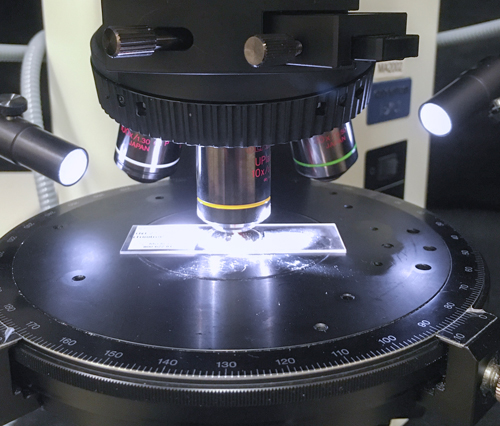
light microscopy (PLM). In spite of a world-class array of analytical
instrumentation, PLM remains our first and most important analytical technique.
The analyst can see the individual particles through the microscope,
even in complex mixtures, whereas bulk analysis can completely miss them.
Even a little titanium white pigment, scattered throughout a work of art,
points to post 1920s creation. The pigment tends to agglomerate, which
is handy for analysis confirmation.
4. Elemental
analysis. We routinely run all samples through the scanning electron
microscope (SEM) for energy dispersive x-ray spectrometry (EDS). This
technique provides an elemental profile of each paint sample and is the
perfect complement to PLM. It can confirm or deny the presence of certain
pigments, and the printed spectra make great, easy-to-interpret figures
for the report (Figure 5).
click image to enlarge (233K)
FIGURE
5
EDS spectrum from a paint sample that included titanium dioxide
and cadmum yellow. |
5. Infrared
spectroscopy (IR) is used routinely for analysis of the medium. Anna
Teetsov, our prize-winning specimen-preparation microscopist, has developed
a number of methods to extract the different components from a paint mixture
for individualized analysis. IR provides information based on the molecular
vibrations of the molecule, and is the most important tool in identifying
organic materials.
6. Raman
spectroscopy (Raman), another technique based on molecular vibrations,
complements IR very nicely. Materials unidentifiable with IR can often
be characterized with Raman, and vice versa. It also complements both
PLM and EDS as well: a Raman spectrum can be obtained from a single particle
on a PLM microscope slide, in mounting medium and under a cover slip.
Also, it can further elucidate the nature of, say, titanium white by showing
the crystal form of the material, anatase or rutile, each of which has
different dates of availability in the 20th century (Figures
6A and 6B).
click image to enlarge (41K)
FIGURE
6a
Raman spectrum of anatase titanium dioxide. |
click image to enlarge (50K)
FIGURE
6b
Raman spectrum of rutile titanium dioxide. |
Coming Attractions
Future columns will discuss in greater detail the analytical
tools and techniques used in the study of paintings and other kinds of
cultural artifacts.
|